
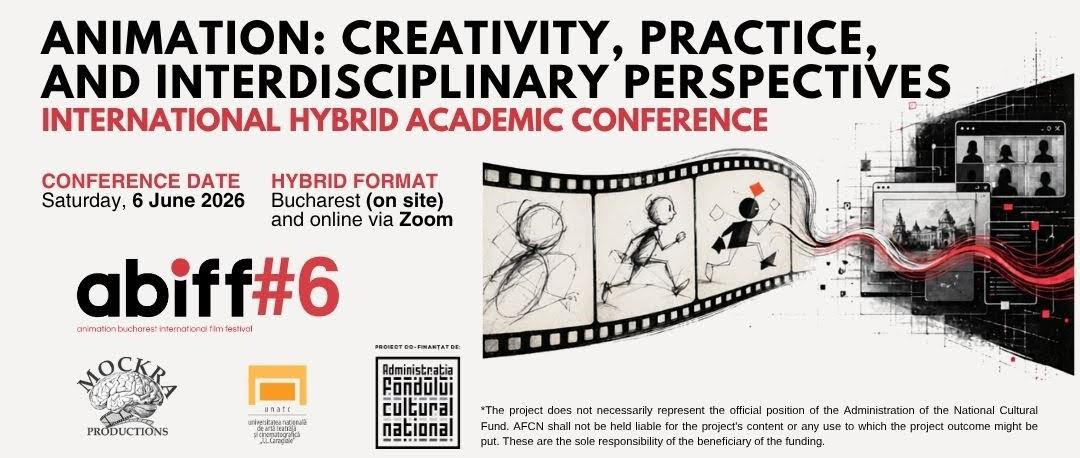
Academic Conference Animation: Creativity, Practice, And Interdisciplinary Perspectives, June 6, 2026
This paper examines the activities of Romanian graphic artists (such as Eugen Taru, Cik Damadian) who created animations and militant graphics in the German Democratic Republic (GDR) during the communist period. The study investigates how the polarized political and ideological climate of the Cold War shaped and influenced these circumstantial productions , converting visual satire from simple paper drawings into a dynamic instrument of psychological warfare and state propaganda.
The central focus of the analysis is the artistic and ideological intersection surrounding the pioneering broadcasts of East German television (Deutscher Fernsehfunk – DFF), specifically the sharp political satire format Zeitgezeichnet (Signs of the Time / Drawn by the Era). Launched in September 1956 under the direction of Walter Heynowski, the show brought editorial caricature to the TV screen. Initially featuring cartoonists sketching in real-time on a large sheet of transparent plate glass in front of the camera, the format rapidly evolved into an early prototype for television animation studios. It incorporated camera movements, double exposures, cut-out techniques, and classic cell animation.
The research highlights how this media platform assembled a prominent collective of graphic designers and cartoonists from the socialist bloc, fostering transnational collaborations and co-publishing initiatives, such as the joint volume Ohne Worte/Berlin published by Romania’s Meridiane and the GDR’s Eulenspiegel Verlag. From an aesthetic and historical perspective, the study tracks the application of Socialist Realism to animated graphics and its deployment as a geopolitical weapon under the GDR’s “West Plan” (Westplan). This strategy aimed not only to consolidate domestic viewers but also to target the West German (BRD) public, systematically deconstructing the West’s “economic miracle,” exposing its military rearmament, and unmasking the Nazi past of leading Western politicians.
Methodologically, this paper relies on documentary analysis and the recovery of private artist archives (including Eugen Taru, Vasile Dobrian, Gheorghe Cernăianu, Gheorghe Ivancenco, Gion Mihail and Romeo Voinescu). By reconstructing these cross-border creative networks, the paper offers a fresh, interdisciplinary perspective on the role of animation as a vehicle for political persuasion and state image-making during the mid-20th century.
Keywords: Animation propaganda, Cold War, GDR, Romanian graphic artists, Political satire, Zeitgezeichnet, Walter Heynowski, Eugen Taru.
Selected Bibliography:
- Fischer, Jörg-Uwe, “Propaganda im Puppenspiel. Politische Puppenfilme des Deutschen Fernsehfunks in den 50er Jahren”, in Medien – Archive – Information, 3/2004, p. 177 ff.
- Petzold, Volker, “Das Trickfilmstudio des DDR-Fernsehens”, in Lexikon des Kinder- und Jugendfilms, 14th supplementary edition, July 2003, p. 1 ff.
- Thiel, Jens; Forster, Ralf, “SS wählt Adenauer. Die Bundesrepublik im politischen Trickfilm des DDR-Fernsehens bis 1961”, in Filmblatt, no. 17, Autumn 2001, p. 26 ff.
- Thiel, Jens; Forster, Ralf, “Leo Haas und der Film. Politische Satire ‘in einer harten, ironischen Weise'”, in Filmblatt, no. 10, Summer 1999, p. 24 ff.
- Heritage Recovery Projects: Graphic Arts Heritage from the Archives of Eugen Taru, Marcel Olinescu, Romeo Voinescu & Illustrators on a Mission: Recovered Collections of Romanian Graphic Arts (1930-1990) (available via postmodernism.ro).
International Hybrid Academic Conference
Animation: Creativity, Practice, and Interdisciplinary Perspectives
6 June 2026
The Animation Bucharest International Film Festival (ABIFF #6), in partnership with the I.L. Caragiale National University of Theatre and Film (UNATC), organizes its International Hybrid Academic Conference as part of the festival’s academic program. The conference provides a platform for dialogue between artistic practice, research, and pedagogy in animation and moving image culture, encouraging interdisciplinary approaches and critical reflflection on contemporary audiovisual and experimental practices. It aims to foster exchange between scholars, artists, and practitioners working across theory and practice.